Does My Business Really Need a Website? Isn't Our Facebook Page or Yelp Profile Enough of an "Online Presence" for Free?
Free is a compelling proposition, especially for a small business managing a tight budget. Setting up a Facebook business page or a Yelp profile costs nothing. Both platforms give you a public-facing presence, the ability to post content, collect reviews, and engage with customers. So why would you need to pay for a website on top of that?
Here's the fundamental problem with this reasoning: you don't own those platforms. They own you.
The Illusion of a Free Online Presence
When you rely solely on Facebook, Yelp, or any other third-party platform as your "online presence," you're getting real estate on someone else's property — and that property comes with rules that can change at any time, without your consent, without warning, and without compensation for any disruption to your business.
Facebook has dramatically reduced the organic reach of business pages over the years, requiring paid advertising to reach even your own followers. Both platforms have changed their algorithms, layouts, and features in ways that affected businesses without notice. Either platform could, theoretically, remove your account for a policy violation — even one you didn't know you were making — and your entire presence on that platform disappears instantly. This is not a hypothetical risk. Businesses across every industry have experienced it.
The Difference Between Renting and Owning
Think of it in terms of physical retail space. A business that rents a location in a shopping center is subject to the landlord's decisions — the lease terms, rent increases, the rules about signage and hours. They can operate successfully in that space, but they don't own it, and their presence there is contingent on the landlord's continued willingness to have them.
A business that owns its building has a fundamentally different kind of stability. They can make decisions without seeking permission from anyone else.
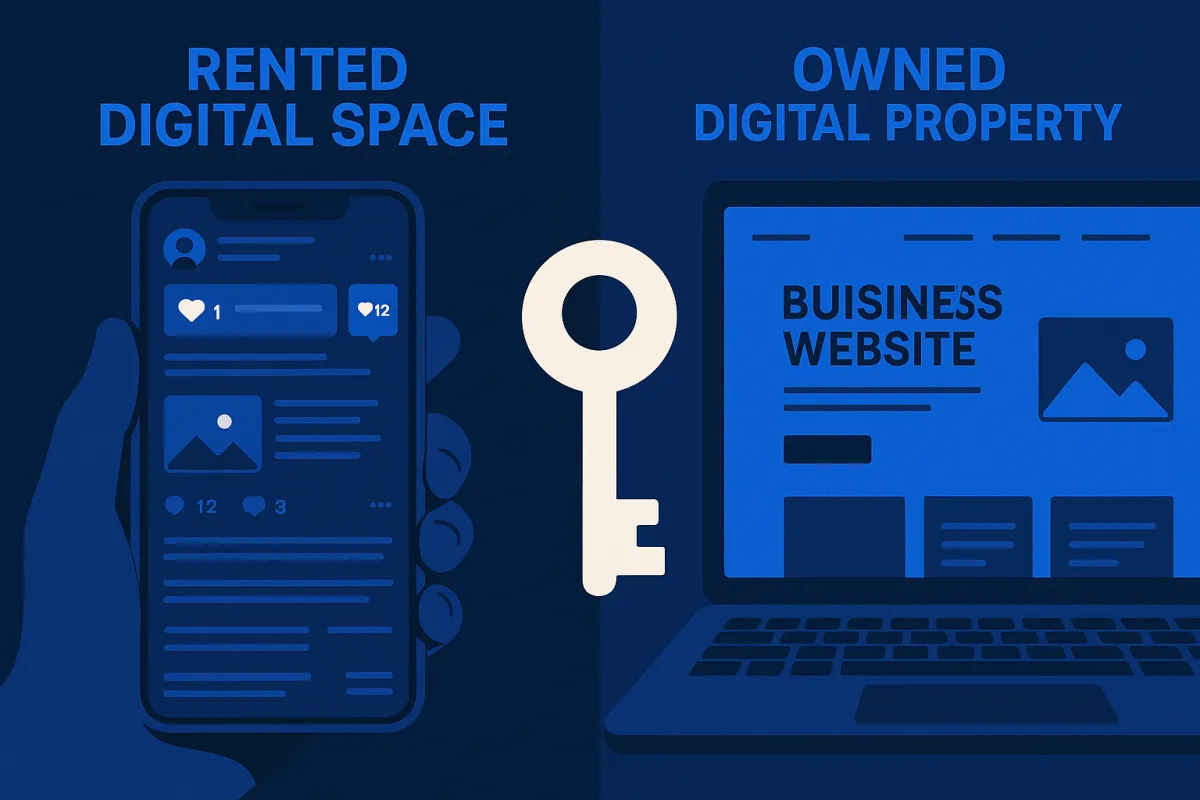
Your website is your owned digital property. Your Facebook page and Yelp profile are leased space on someone else's platform. Both have value — but only one of them belongs to you.
What a Website Does That Social Profiles Cannot
Complete brand control. Your website looks and feels exactly the way you want — your colors, your fonts, your imagery, your voice. Social platforms impose their own templates that limit your ability to fully express your brand.
Search engine visibility. Google indexes websites for organic search. A well-optimized website is what appears in results when someone searches for your service in your city. A Facebook page is far less likely to rank for those searches.
A central hub for your entire digital presence. Your Google Business Profile links to it. Your social media bio links to it. Your email signature links to it. It is the authoritative digital home for your business — the place where all roads lead.
Integrated tools and functionality. Appointment booking, automated follow-up, contact forms, service galleries, payment processing — your website brings these together in a cohesive, branded experience that social platforms simply can't replicate.
Data and analytics ownership. When you own your website, you own your visitor data. You can see who visits, what they look at, how long they stay, and where they came from. On social platforms, that data is theirs to keep.
How Social Media Should Actually Work
Social content and social profiles are excellent tools for generating awareness and reaching new audiences. But their job is ultimately to drive traffic to your website — where your business is presented on your own terms and potential clients can decide to contact you or book a service. Without a website, the journey ends at the social profile, which is insufficient for the full arc of turning a curious prospect into a paying client.
Your Facebook and Yelp pages are valuable tools. Let's make sure they're working for your website — not substituting for it.
👉 Explore PagePlatform Plans — Your Digital Headquarters, Built Right