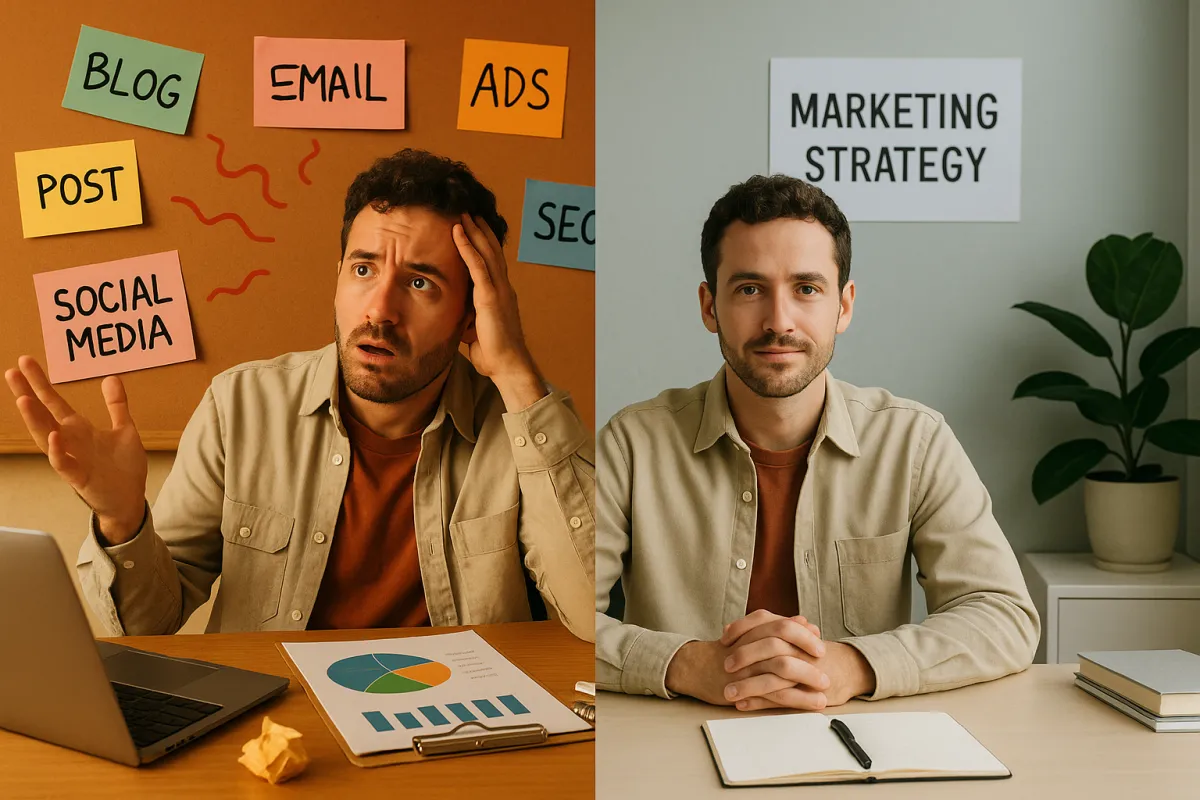
What Is the Difference Between Guessing Your Marketing and Having a Clear Strategy?
Most small business marketing falls into one of two categories. The first is a collection of activities that feels like marketing: posting on social media when there is time, running a promotion occasionally, spending on ads and hoping for results, asking customers for reviews when it comes to mind. The second is a connected plan with a clear goal, a defined audience, a chosen set of channels, a content approach, and a way to measure whether it is working.
The difference between the two is not the amount of effort invested. It is the clarity of the thinking that happened before the effort started.
What Guessing Looks Like in Practice
You post content when inspiration strikes, without a topic plan or publishing schedule. You run ads without a specific, measurable goal or a plan for evaluating whether they are producing returns. You try a new platform because a competitor appears to be on it, without knowing whether your audience is actually there. You spend on marketing consistently but cannot tell afterward how much of it produced any result. You keep doing the same things because you have always done them, even when the evidence that they are working is absent.
None of this is lazy or careless. It is what marketing looks like without a strategy. And it is the reason so many small business owners feel like marketing is expensive and unpredictable.
What Having a Clear Strategy Looks Like
You know who your ideal customer is, in enough detail that you can recognize their situation and speak directly to their concerns. You know how they typically find and evaluate businesses like yours, because you have asked your best clients and paid attention to the pattern. You have chosen your marketing channels based on where your ideal customer actually spends time, not based on what is trending or what a competitor is doing. You have a content approach built around the questions and concerns your ideal customer already has when they are searching for what you offer. You track a small number of clear metrics, such as monthly new leads, website traffic, review growth, and close rate, so you can see whether your marketing is producing results. You make decisions based on what the data tells you rather than what feels right, and you adjust when something is not working rather than continuing to invest in it.
The Gap Is About Thinking, Not Budget
The difference between guessing and strategy is not primarily about budget. Some of the most effective small business marketing strategies cost very little to execute. The gap is about taking the time to think clearly before acting: understanding the audience, choosing channels based on fit rather than familiarity, setting a specific goal, and building a feedback loop that tells you whether the investment is working.
A business with a clear strategy does not need to do more marketing. It needs to do the right marketing, directed at the right people, in the right places, with a clear sense of what success looks like. That focus is what separates businesses that grow steadily from those that spend inconsistently and feel like they are always starting over.
Start With a Clear Picture of Where You Stand
If you want to move from guessing to strategy, the first step is understanding your current position clearly. ReachRadar is a free tool for small business owners that provides a personalized assessment of your online presence and specific, actionable recommendations for where to focus first.
Get your free assessment at reachradar.app.
If you want a managed content marketing strategy built around your specific business, audience, and goals, with consistent execution and measurable results, ContentContractor by Dillon Digital Solutions provides organic online marketing management for small businesses that replaces guesswork with a real plan. Learn more at dillondigitalsolutions.com/contentcontractorsvc.