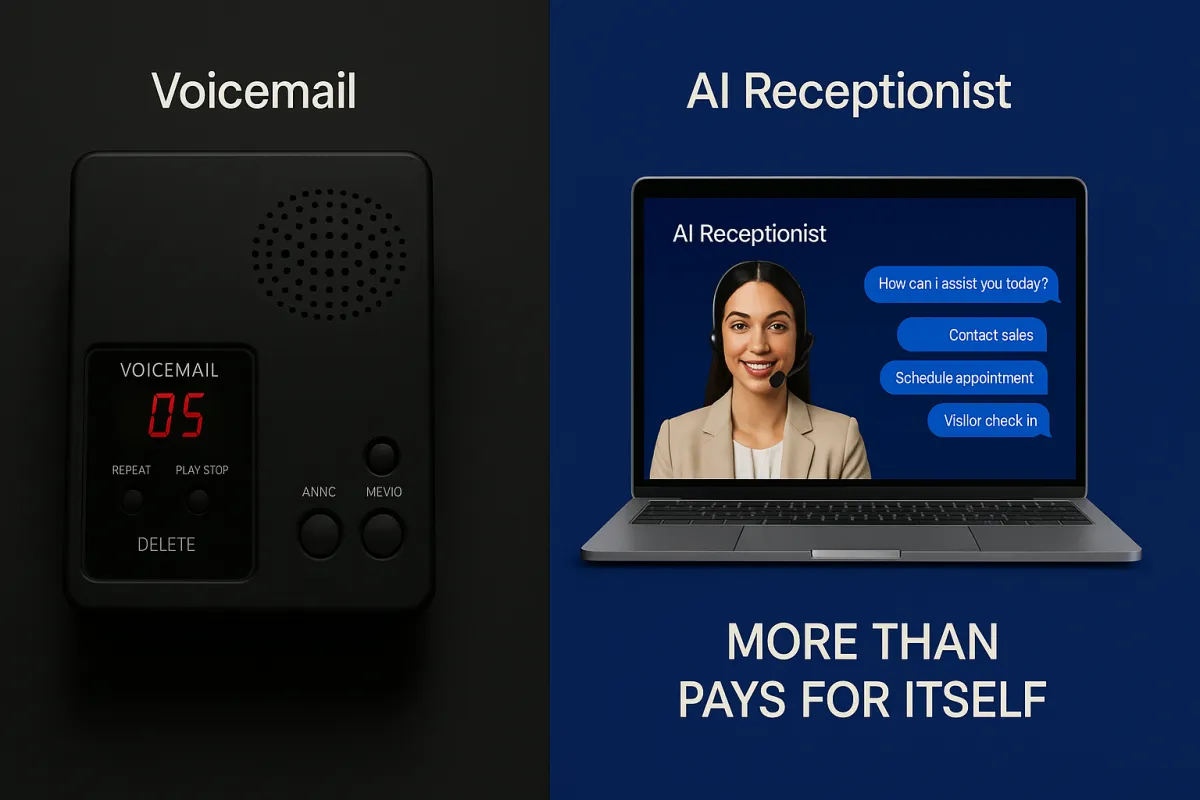
Why Should I Pay Hundreds Per Month for an AI Receptionist When Voicemail Is Free?
Voicemail Is Free. But Missed Leads Are Not.
The case for voicemail — or for a traditional answering service — sounds compelling on the surface. It is cheaper. It is familiar. It has been part of business phone systems for decades. If calls are coming in, at least something is there to capture them.
But the question of whether voicemail is cheaper than an AI-powered virtual receptionist depends entirely on what you count as a cost. And when you count what voicemail actually costs most small businesses, the math shifts dramatically.
What the Data Shows About Missed Calls
A study by 411 Locals monitored the phone lines of 85 small businesses across 58 industries for 30 days. The results were significant: those businesses answered only 37.8% of their incoming calls. Another 37.8% went to voicemail, and 24.3% received no response at all.
In other words, nearly two-thirds of all incoming calls to small businesses do not reach a live person.
Now consider what happens to those callers who land in voicemail. Research consistently cited across the customer communication industry confirms that approximately 80% of callers who reach a business voicemail hang up without leaving a message. They do not wait. They do not try back later. They have a need, they have options, and they move on to the next provider on their list.
Industry data from multiple sources indicates that 85% of unanswered callers never attempt to reach that business again. For the remaining callers who do try again, many have already contacted a competitor in the interim and do not return.
What a Cheap Answering Service Provides
Traditional answering services — the kind that employ live operators to take messages — solve one specific problem: a real person answers the phone. Beyond that, the limitations are significant.
Live answering services employ operators who handle calls for many different businesses simultaneously. They work from a basic script and limited information about your company. They cannot answer specific questions about your services, pricing, or availability with any depth. When a caller asks something outside the script, the operator typically takes a message and promises a callback.
Which brings the outcome back to roughly the same place: the caller hangs up without the information they wanted, your business gets a message to follow up on, and the caller begins evaluating other options while they wait to hear from you.
Traditional answering services also typically cost $300 to $500 per month for a modest call volume, with additional charges for after-hours coverage and higher call volumes. For that investment, you are still not getting a knowledgeable, available representative who can actually handle the call on your behalf.
What an AI Receptionist Actually Provides
CyberConcierge, starting at $297 per month, provides something that no voicemail system and no generic answering service can: a fully trained representative of your specific business, available 24 hours a day, that can answer actual questions, collect detailed contact information, and create a qualified lead record for every caller it speaks with.
The system is trained on your services, your pricing, your policies, and your industry's terminology. A caller who reaches CyberConcierge gets an experience that reflects your business — not a generic invitation to leave a message after the beep.
That difference in caller experience has a direct financial consequence. A caller who receives a useful, responsive interaction is significantly more likely to leave their contact information, ask a qualifying question, and engage further with your business. A caller who reaches voicemail or a generic answering service is more likely to move on.
Running the Numbers on Your Business
Here is a practical framework for evaluating the cost comparison for your own business.
Estimate how many inbound calls your business receives in a typical month. Apply the 62% industry average for unanswered calls. Of those unanswered calls, estimate how many were from potential new clients. Then apply an average value for a new client relationship in your industry.
For a business receiving 40 calls per month, that means roughly 25 calls are going unanswered. If even 10 of those are from potential new clients, and even a fraction of those would have become clients if answered, the revenue at stake dwarfs the monthly cost of CyberConcierge several times over.
Voicemail costs nothing per month. But for most service-based businesses, it costs far more in lost opportunities than any reasonable phone solution would.
The Free Trial Changes the Calculation
The cleanest way to evaluate whether CyberConcierge is worth the investment for your business is to run the trial. No payment information required. No commitment. One week of your receptionist answering calls that would have otherwise gone unanswered, and a clear record of every contact captured.
At the end of that week, you are not making a theoretical decision based on industry statistics. You are looking at the actual calls your receptionist answered, the actual leads it captured, and making a judgment call about what those contacts are worth to your business.
For most businesses, that first week answers the question entirely.
Sources: 411 Locals Study (62% of small business calls go unanswered; only 37.8% answered by a live person); Dialzara (80% of callers who reach voicemail hang up without leaving a message; 85% of unanswered callers never try again).